


|
| | LDAR
Compliance | | |
LDAR Audits | | EnRUD
Resources, Inc. has the experience and LDAR regulatory knowledge to perform any
of the following audits listed below: - Texas
HRVOC Audit
The state of Texas has
recognized the necessity to control highly reactive volatile compounds (HRVOC)
within the non-attainment areas where ozone creation is a great concern. One of
the state's answers to the problem is focusing on the control of these compounds,
hence the state of Texas has adopted new control requirements (Chapter 115, Subchapter
H). Within Subchapter H, a new section for controlling highly reactive VOCs from
equipment leaks was added, Subchapter H: Highly-Reactive Volatile Organic Compounds,
Division 3. This division addresses the HRVOC fugitive emission aspect of the
regulation. When creating this division, the state of Texas also recognizes the
importance of ensuring that the intent of the regulation is not being compromised
by including an audit section. Every facility regulated by the new HRVOC rule
in the Houston/Galveston non-attainment areas will be required to perform yearly
an independent third party audit. The audit is comprised of three segments: 1)
A field audit 2) Comparative monitoring & Method 21 procedure adherence 3) Review
of previous monitoring data. The field audit will be the review of the proper
procedure for the tagging of leaking valves that are placed on shutdown. The second
aspect, comparative monitoring, dictates when and how many valves will be selected
randomly based on leak rates. The third aspect will require an individual with
database and LDAR regulatory knowledge to evaluate the monitoring process.
- Comparative
Monitoring
Comparative Monitoring
is selecting components in a monitoring program based on a class/classes and a
pre-determined percentage. The pre-determined percentage can be decided by a facility
or if the comparative monitoring is a regulated comparative monitoring, then the
regulation will provide the percentage. Components are selected randomly and then
monitored by experience monitoring personnel. A report providing the findings
and leak percent calculations will be provided to the customer. Comparative monitoring
is a quality assurance tool that allows customers to compare the leak percentages
found against their contractor's or in-house's monitoring leak percents.
- LDAR
Customized
Customers
can contract EnRUD to perform customized LDAR audits. Customize audits allow customers
to focus on problem area by allowing them to select the kind of audit that best
fits the facility. There are many aspects to a LDAR program and each customer
has different strengths and weakness. With this customized audit, a customer can
change a program's weakness into a strength. To get ideas on selection of items
to customize your audit, click here for Third
Party Audit Guidance by EnRUD Resources, Inc.
- LDAR
Tagging
LDAR tagging audit is reviewing
the tagging of the equipment in the field using P&IDs and a master component list
provided by the LDAR data management program. The audit requires experience personnel
who can read marked up color coded P&IDs and LDAR regulatory knowledge. This knowledge
is necessary to ensure and verify that the proper equipment is identified and
coded correctly in the master component database. EnRUD has experience and knowledgeable
LDAR personnel who have performed LDAR tagging projects.
- Consent
Decree
Many refineries have signed a
Consent Decree with the EPA. Within these Consent Decrees, the EPA added a section
for LDAR audits. The refineries have to contract a third party auditor to perform
an audit on their facility based on specified requirements listed in their Consent
Decree. EnRUD has the LDAR experience and the regulatory knowledge to perform
these audits.
- LDAR Contractor
- Simulated
NEIC
The NEIC (compliance enforcement,
branch of the EPA) every year perform audits on selected facilities to ensure
compliance. These audits are rigorous and cover of many areas. One of the areas
that the NEIC covers is LDAR. A way to prepare an EPA LDAR audit is to go through
a simulated NEIC audit. This audit is much like the one that the facility would
receive from the NEIC. If you haven't had the fortunate opportunity to go through
a NEIC audit then this is the opportunity to prepare for it. EnRUD has the LDAR
experience and the regulatory knowledge to perform these audits.
|
| Top |
Browser Based Regulatory Interpretations |
- 40 CFR 60 - VV
- 40 CFR
63 - GGG, MMM
- 40 CFR 61 - V
- 40
CFR 264 - AA, BB, CC
- 40 CFR 63 - H, UU
- States
- Louisiana & Texas
|
| Top | LDAR
Personnel Training | - EPA Method
21
EnRID provides in depth training
on the EPA Method 21 that virtually every LDAR regulation references. EPA Method
21 is the method for proper selection of analyzers, proper calibration and certification
of analyzers, and proper monitoring procedure on how to monitor equipment. In
this training class, a person will taught how to select an instrument, how to
calibrate an instrument, how to certify the instrument, and how to monitor equipment
with an instrument. The training also discuss how and where to monitor on several
class and types of equipment. For information on computer base training
for EPA Method 21, click here.
- LDAR
Introduction
For first time beginners
into the LDAR (leak detection and repair) industry, this training will introduce
new comers basic information about the Leak Detection and Repair industry. The
training covers EPA Method 21, regulations, database management programs, instrumentation,
and dataloggers.
- Federal & State
Regulations
- LDAR Technician I & II
- TVA-1000B
Analyzer
- LDAR Coordinator
- LeakTracker™
System 200
- LDAR Audit Preparation
|
| Top |
LDAR Software Services | |
| Top |
LDAR CBT | - EPA
Method 21
EnRUD offers CD-ROM Based
Training Covering EPA Method 21. Provides in depth training on the EPA Method
that virtually every LDAR regulation references. The training packages contain
numerous equipment diagrams and bitmaps and animated gif's that show your personnel
how and where to monitor. Detailed procedures guide you through how and why you
perform daily calibrations and the quarterly performance evaluations on the portable
gas detectors. The training package not only clearly explains EPA Method 21, it
also gives real world experience to the application of the Method.
- LeakTracker™
System 200 / M.A.R.S.
EnRUD offers LeakTracker™
200 System CD-ROM based training covering the M.A.R.S.® Software. This training
package familiarizes your personnel on how to use the M.A.R.S. software. Detailed
procedures will guide you through the M.A.R.S. introduction and setup, to configuration,
uploading & downloading, and how to use the Alpha & other functions keys. This
training package will also expose personnel to the database structures used within
M.A.R.S. Overall, this is the FastTrack to learning all there is needed for the
M.A.R.S. Software
|
| Top | Cooling
Water Tower Testing | Cooling
Water Tower Testing As of January of 2003, the TCEQ has adopted a new modified
El Paso method (Appendix P). In this modified method certain criteria have to
be met before this method can be utilization and a QA/QC procedure has been added
which was not provided in the previous El Paso method. Previously,
the FID analyzer that was utilized could be of analog type readouts that were
design to read much higher concentration and not design to measure the lower concentration
levels typically found in cooling water. FID analyzers used in conjunction with
the new method must be a digital readout (readable to 0.1 ppmv), must be able
to calibrate to low methane concentrations (e.g. 5, 10 ppmv) and have a sampling
rate less than 2000 ml/min. The QA/QC section of
the method now requires semi-annually certification of specific components of
the cooling water tower apparatus. These components are: air rotameter, water
rotameter, and the temperature gauge. EnRUD Resources,
Inc. (EnRUD) has the experience and the equipment to perform necessary QA/QC on
the cooling tower water apparatus and the knowledge to perform cooling tower water
testing with the procedure incorporated in the TCEQ sampling procedures manual.
For facilities that utilize continuous emission monitoring
systems (CEMS), EnRUD can be contracted to be your facilities backup in the event
that your CEMS fails.
- Cooling
Water Tower Testing Apparatus
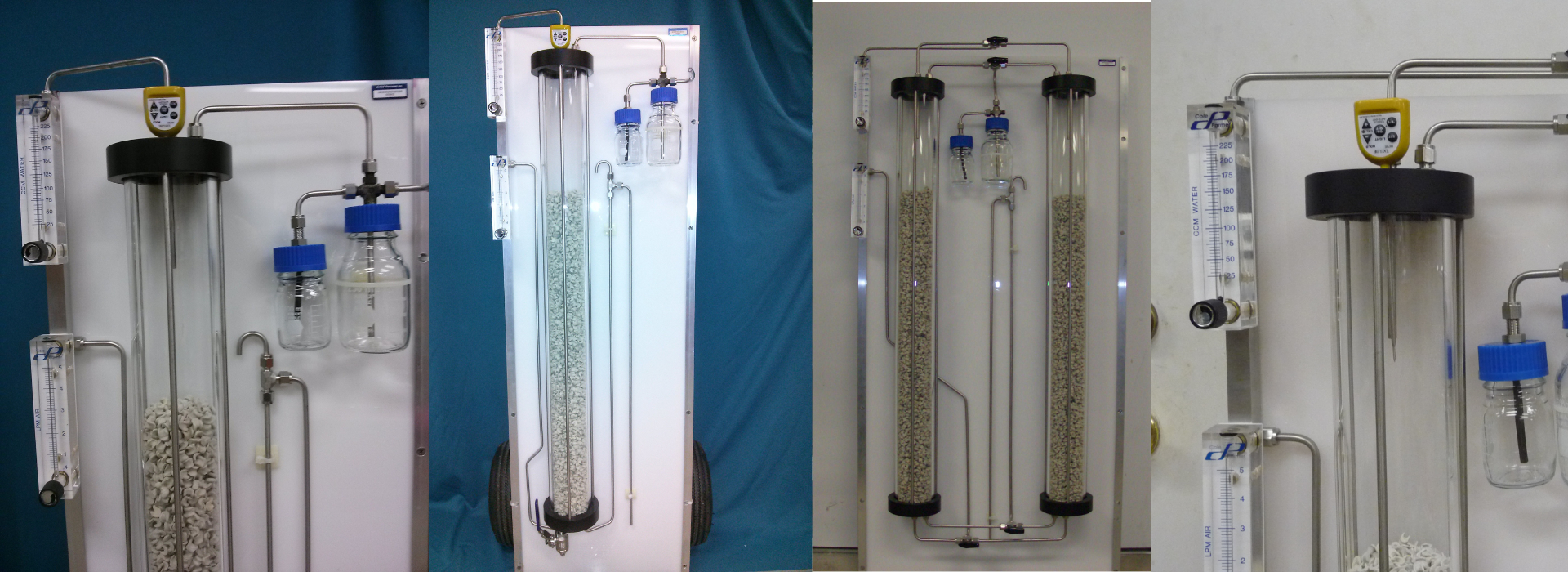
The
cooling water tower testing apparatus is utilized in performing the new El Paso
method (Appendix P) on cooling water towers in the state of Texas. This testing
apparatus is a professionally built and meet the specification requirements of
the TCEQ Appendix P for testing cooling water towers. Purchase
ready to use - VOC Stripper System, El Paso - Click here for pricing
- Cooling
Water Tower Testing Apparatus
Certification TCEQ's Appendix P requires the air/water rotameters and temperature
gauge to be certified on a semi-annual basis. The air/water rotameter and temperature
gauge are shipped or delivered to EnRUD to be certified by experienced personnel
in accordance with Appendix P. Certification papers are provided to demonstrate
compliance.
| | SOPs | |
| Top |
Response Factor | |
| Top |
Bagging | |
| Top | LDAR
Audits | Regulatory Interpretations
| LDAR Personnel Training | LDAR Software Services
| LDAR CBT SOPs | Response
Factor | Bagging | |